Coaching and the Climate Crisis

Farhana Yamin, the Extinction Rebellion environmental lawyer, when asked at the Hay Festival last year, “What do you say to climate change deniers?”, replied: “Nothing, the time for that discussion is long gone”.  Derrick Jensen, in his book, ‘Endgame’, asks, “Give me – and more importantly yourself – a specific threshold at which you will finally take a stand”[1].  How bad does it have to get before enough is enough? I have been committed to the environmental cause since 2007 and have now reached my own tipping point.

I find myself challenged to the core. “I don’t want to talk about hope, only action” says Greta Thunberg.  The slogan, ‘Hope for the best, prepare for the worst’, seems about right.  In June, the government produced, a ‘Community Resilience Development Framework’, – ‘a reference tool to inform strategic approaches through Local Resilience Forums in collaboration with non-statutory partners’.  It describes this as ‘a participatory approach to emergency management’.  All hands-on deck then.  Clearly some compasses are aligning in high places.  It’s interesting though that whilst the Guardian has recently committed itself to a new lexicon more fitting to the climate crisis, government-speak has gone the other way; ‘Community Resilience’ is the new ‘Disaster Planning’.

How to respond to this? Here’s a small practical suggestion:  coaching focusses on the future, identifying positive goals and actions.  You may feel that might be a bit of a stretch given the current political and environmental climate but, Greta is right, proactivity is an antidote to despair.  I would therefore like to offer a free coaching session to anyone who wants to take a concentrated, head-on approach to their own response to the climate crisis.  Whether you’re new to activism or a seasoned campaigner trying to re-group and work out what comes next, I would love to hear from you.  Please get in touch.

  1. Endgame Volume 1: The Problem of Civilisation (2006)  Derek Jensen
  2. Community Resilience Development Framework:

https://www.gov.uk/government/publications/community-resilience-development-framework

Image by cocoparisienne from Pixabay

[1] Derek Jensen 2006 as cited in ‘Drinking Molotov Cocktails with Gandhi’ by Mark Boyle (2015) p.72

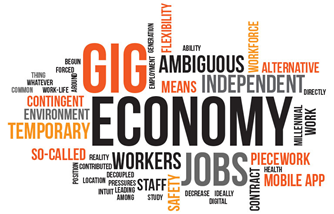
The Idiot’s Guide to the Gig Economy

I started to use the term ‘Gig Economy’ before I had half a clue what it meant – I was that idiot. So here are a few things about it that might bring some clarity:

Definition and Background:

The term ‘Gig Economy’ was coined during the 2009 financial crisis and referred to the emerging business models embracing the new technologies and on-line platforms in particular.  ‘Gigging’ had its roots in the 1920s Jazz scene where musicians were hired for one off performances and paid on a casual basis[1]. Similarly, workers within the Gig Economy tended to be self-employed on contracts that were often temporary, zero-hour, low-paid and without benefits such as sick and holiday pay and pension contributions. With the rise in unemployment at the time of the recession, workers were often obliged to work a number of part-time jobs to make ends meet. This also co-incided with UK government policy post 2010 to privatise many areas of the Public Sector by contracting services out. There was a fanfare of kick-starting business innovation, entrepreneurship and creativity coupled with a ready pool of increasingly cheap (and de-regulated) labour.  So the UK witnessed the rise of companies such as Uber and platforms like Amazon, Airbnb and Etsy, whilst other businesses took advantage of contracting out to reduce costs (think delivery – eg., M&S, Deliveroo, DPD etc.)

Why is this significant?

Anybody concerned with emerging trends in business, careers, employment, employability and young people in particular should be taking note.  The speed of the expansion of the Gig Economy has taken many by surprise.  A recent article in the Guardian by Richard Partington reported that there are now nearly 5 million workers in the Gig Economy[2].  Research carried out by Herts University found that 1 in 10 workers do ‘gig’ work every week.  This has doubled in 3 years.  60% of these workers are aged 16-34[3]. The work is wide-ranging and includes, for example, couriers, deliveries, taxis, office work, design, software development, cleaning and household repairs. Neither is the Gig Economy confined to the UK – the USA and Europe report similar trends.  Hot off the press – Deliveroo, for example, operates in 13 countries – including Australia, Belgium, France, Hong Kong, Italy, Ireland, the Netherlands, Singapore, Spain and the United Arab Emirates[4].

Winners and Losers:  It’s not that simple…….

Entrepreneurs and Shareholders: They say that nature hates a vacuum and it seems the economy is no different.  The gaps in the market created by the decline in many sectors, together with loosening employment regulation has given rapid rise to the so-called Unicorn companies – tech companies that have reached $1billion market value (eg. Uber, Airbnb). But there’s high risk with rapid expansion – Deliveroo for example is facing a loss of £232 million this year despite doubling its operation[5].

Workers: For some who find it difficult to access the traditional job market the Gig Economy is a way in to get valuable work experience with fewer recuitment barriers, which may explain why young people are over-represented in the statistics.  However, for those who need a living wage from it, it’s not a good long-term option.  Weekly and monthly income fluctuates and is often insecure, leaving vulnerabilities around housing and bills.  Foodbank data shows that many more families who are working are accessing their services – under-employment is a growing feature in our economy which skews the official employment data.  There are some workers, however, who like the zero-hour flexibility but these tend to be those for whom the Gig Economy is a useful supplement to their main income.  In addition, goods and services providers such as artists, crafters, clothing retailers often prefer to work in this freelance way.

The Government: There’s no doubt that the Gig Economy increasingly contributes to the UK GDP, (although I’ve yet to see a figure put on this).  There should be the additional benefit of taxation both from businesses and workers but we know that collecting what’s owed is easier said than done. Underemployment remains a concern.  For example, a pilot in the West of England, ‘Future Bright’ which is an initiative to support this group into full-time work, has just been extended.

The need for regulation:  The push-back has started.  The unions have been active, with court cases against high profile companies such as Uber gaining traction and local authorities refusing to renew licences to operate.  Individual stories in the media, such as the death in 2017 of Don Lane, a DPD driver, have also highlighted the poor working conditions. The government has indicated that it is committed to forming future regulations, but a no-deal Brexit (apologies for mentioning it) threatens to sever the links with the EU – a long term protector of employment rights.

Job seekers may not have the luxury of avoiding the Gig Economy but take care to see it as a short-term stepping stone to more rewarding, better paid, more secure work that provides sick, holiday and pension pay. And don’t forget to check whether you will need to pay tax!


[1] Financial Times 2015 https://www.ft.com/content/b5a2b122-a41b-11e5-8218-6b8ff73aae15 

[2] Richard Partington Guardian Newspaper 28.6.19

[3] University of Hertfordshire 2016 https://www.herts.ac.uk/about-us/news/2019/june/uks-gig-economy-workforce-has-doubled-since-2016,-university-of-hertfordshire-research-shows

[4] Sarah Butler Guardian Newspaper 3.10.19

[5] Sarah Butler https://www.theguardian.com/business/2019/oct/02/deliveroo-makes-232m-loss-despite-doubling-its-operation

Tackling Procrastination

At the start of a coaching session I always ask my clients how they have got on with the goal and actions that they had identified and set themselves at our last meeting.  In truth I’m just as interested in what they haven’t done as what they have.  Conscious or unconscious, neglected actions are always significant.

Sometimes an action becomes obsolete in the light of new information that takes the client down another route.  This is common and to be expected.  Less common is the genuine crisis that has occurred  – I consider, ‘I broke my leg’ to be a legitimate excuse for example, (although I remember once saying something similar to a friend who, clearly annoyed by my lack of communication, asked if there was anything wrong with my (texting) thumb and forefinger.)

The reason that interests me most as a coach though, are those neglected actions that evidence some level of procrastination – when you don’t do what you said you would, even if you know it will benefit you. There’s only ever one real reason for procrastination and that’s that you don’t want to do it – or at least, not enough. We always find time to do the things we want to.

I have empathy with this.  I have well-honed procrastination skills myself and if it wasn’t for my personal coach and supervisor, who don’t let me get away with anything, you would be able to accuse me of hypocrisy. One advantage for me is that it makes me particularly good at spotting procrastination in others.

For those who fear making decisions, procrastination has its uses.  Wait long enough and the situation may go away.  As I used to say regularly to the school leavers I worked with who ‘just wanted a job’ and were reluctant to apply for college as a plan B, ‘Not making a decision does eventually become a decision’.  Missed opportunities are just one consequence of procrastination.

More serious consequences might arise, for example, by not dealing with money issues or debt; not having those ‘crucial conversations’ with colleagues or a loved one; or not seeking out medical advice when we know we have a worrying health symptom. Clients will sometimes confess to being ‘lazy’.  This is rarely true.  People who are motivated enough to seek out a coach and pay for their services usually have a good measure of motivation for change. Something else is going on.

Most often though, the root of procrastination is fear. Being out of our comfort zone is uncomfortable, unsettling and potentially stressful –  examples such as asking for information or help, or trying something new,  or speaking to people we don’t know (or don’t like or who scare us),  or going to places that are unfamiliar, are all things that potentially make us feel vulnerable.  In coaching, we refer to this as being in the ‘stretch zone’ and to be perfectly frank, this is where we want our clients to be (at least some of the time).  There’s limited growth without it.

Rather than focussing on the fear though, and its accompanying emotions, we encourage our clients to envisage and think about the benefits of being on the other side – the resulting opportunities, possibilities, joy (and of course relief); and ultimately finding out things about themselves in the process that equips them with the confidence and motivation to keep going towards their goal.  Susan Jeffers in ‘Feel the Fear and do it anyway’ was one of the earliest self-help psychologists to pioneer the idea that we can train ourselves out of our old thought patterns. She recommended developing a new mantra – ‘I can handle it’ (‘it’ being whatever you’re facing at the time).

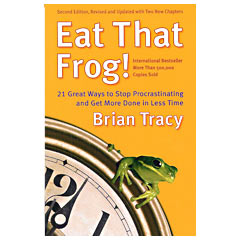
Brian Tracy’s international bestseller on getting organised, recommends ‘Eating the Frog’ – doing the distasteful thing first and getting it out of the way, especially if it’s something that once tackled has the potential to make a huge difference. And that’s an important point to make – I’m not talking about catching up with the housework or tidying your desk (although sometimes these are good things to do). No, these are the significant things that, once tackled, can move us on in all sorts of ways.

So if, as you’ve read this, there’s a niggling suspicion in the back of your head that I’m talking to you personally, here’s an anti-procrastination tool for you to try:  5 questions and an activation.  Try it now – eat those frogs – and if you want some accountability – let me know when you’ve done something!

Five Questions:

  1. What am I procrastinating over? (make a list in order of importance)
  2. What are each of these procrastinations costing me? (not necessarily financial)
  3. What are the benefits of getting these sorted? (ie. How important?)
  4. What will happen if I don’t take action?
  5. Which procrastination, if I took some action, could potentially have the biggest impact on my life?

Activation:

Choose a procrastination and break it down into tiny small steps (make a list).  Decide what you’re going to do first and when. Put the dates in your diary/in your phone. Stick the list on your mirror (or something else creative). Ask someone to keep you accountable.  Remind yourself that keeping promises to yourself is a key value.  Repeat to yourself ‘I can handle this’. Eat that Frog. Reward yourself when completed if that will help.  Keep in mind how great you will feel when it’s done and the benefits you will be able to enjoy as a result. Cross it off the list when it’s done. Now how do you feel?

Resources: 


When is a Job not a Job?

Fake jobs are not a new phenomenon but with the increased use of Social Media for job search, it is a worrying and growing trend.  I first came across it when someone I knew applied for a job through a local recruitment agency.  When he went for interview, he was told the job had already gone but would he be interested in others they had on offer?  He had, apparently, experienced this elsewhere, and felt it was becoming more common.  It was unclear if the job had ever existed but was a good way for recruitment agencies to identify a ready supply of potential workers for future vacancies.  This is disappointing for the applicants and far from a transparent tactic of certain agencies.

This isn’t the only way that fake job appears, writes Tom Pinder, in an article on the luminate.prospects website (see link below).  The most common are those websites that allow individuals to post photographs of locally advertised jobs in return for rewards (eg. Amazon vouchers).  These are often genuine jobs in small businesses who benefit from broadening their advertising reach.  However, the downside is that it leaves a way for scammers to peddle fake jobs.

To be fair, the recruitment sites/job boards do make efforts to detect and remove fake job adverts, but time and effort can be wasted on completing application forms for jobs that don’t exist.  Sometimes legitimate business addresses are used when no actual vacancies exist.

SAFERjobs (see link below) has reported that since 2016 there has been a 300% rise in recruitment related fraud and misconduct.  So what do the scammers gain from posting fake jobs? Money, of course – directly through things like premium rate phone calls for interviewing; money laundering through work-from-home scams; fees for phoney background checks, training, visas and insurance.  Indirectly, they might be able to illicit dates of birth and personal bank details.  More worryingly though and far more sinister is a link that has been found with people trafficking and slavery. The National Crime Agency (NCA) reported that people trafficking in the UK has witnessed a 35% increase.  Often people are entrapped through the promise of a new job and life.

What can Job seekers do?:

  • Report any suspicious job adverts to Action Fraud (see link below)
  • Research employers thoroughly – check websites, visit beforehand, talk to employees etc.
  • Be wary of jobs where the whole process (including the interview) are done on-line
  • Don’t include your Date of Birth or bank details in applications or CVs
  • Be careful using Social Media for job search – it is unclear if and how scammers might be working but there clearly is a growing potential for it

“Be wise as serpents and innocent as doves” says Jesus of Nazareth – timeless advice, I’d say.

Useful Links:

Action Fraud:  https://www.actionfraud.police.uk/

SAFERjobs:  https://www.safer-jobs.com/

Modern Slavery Helpline: https://www.modernslaveryhelpline.org/

Data Source:  Tom Pinder December 2018 https://luminate.prospects.ac.uk/the-rise-of-fake-job-adverts-and-recruitment-fraud-

Business for Bohemians by Tom Hodgkinson

This little gem of a book was the best business book I read in 2018 – ideal for sole traders, SMEs and those wanting to gain insight to the entrepreneurial employer perspective or just for fun.

Tom Hodgkinson, founder of the magazine ‘The Idler’, and with a background in running a book shop, café and school (intriguingly called the ‘Idler Academy of Philosophy, Husbandry and Merriment’), is full of practical, pithy wisdom, gleaned from failures, setbacks and with fawltyesque humour.  He is first and foremost a writer, perhaps best known for his treatise on ‘How to be an Idler’ (free ebook by the way).

Even the chapter headings draw you in – ‘Never, ever, overwork’; ‘How to deal with your enemies’; ‘The power of laziness’; ‘How to be Stoic’; ‘The joys of quitting’. Don’t be fooled though, he covers all the business basics (‘The art of accounting’; The disappointments of Social Media and how to get it right’; ‘Get the price right and get paid’).  The chapter on ‘Learn to love the spreadsheet’ inspired me to completely rethink my accounting habits – just because it was so down-to-earth and do-able.

I even read a page of it to an employability workshop I ran recently – on the vagaries of trying to find suitable employees (who weren’t idle).  ‘Don’t use free Job sites’ he advises fellow employers after a bad experience. Critical of poor CVs (‘cut and pasted; illiterate; repetitious, with streams of ‘hyperbolically laudatory epithets’ with often irrelevant, insufficient work experience’), he recommends word of mouth, networking or using a ‘decent recruitment agency’.  Job seekers, centres and coaches take note!

Business for Bohemians by Tom Hodgkinson Penguin Random House UK 2016 ISBN 978-0-241-24479-1


Understanding the UK Job Market

Having worked in and around the UK Labour Market since 2002 I’ve noticed some key changes in the way it operates. The 2008 Economic Recession proved a major turning point and has had a bewildering impact on those looking for work ever since.  Over time, on average, jobs now take longer to find and are lasting for less time. Most people are likely to return to the jobs market many times during their working lives.  I don’t consider my experience exceptional but I have had fourteen jobs since 1976 and four since 2008.

The rise of technology (and automation in particular) is transforming the nature of work in most fields.  In connection with this, one of the biggest changes for job searchers and career changers has been the increased use of the internet, and particularly social media, to advertise and recruit personnel. For those who are less computer savvy or who, for whatever reason, don’t have direct access to the internet, job search can be doubly stressful.

Employers have changed their recruiting tactics too.  Most businesses advertise through their websites and for some of the bigger employers that’s mostly all they do – the large retail and banking chains are good examples of this.  Smaller employers prefer methods that are lower risk and lower cost and research has shown that increasingly ‘word of mouth’ recommendations are the preferred method. Job Centre data suggests that 33% of men and 25% of women find jobs through people already employed in the organisations they target. (This has become known as the Hidden Jobs Market – jobs that are never advertised). For skilled, professional and managerial roles the percentage finding jobs through word of mouth is higher than the figures mentioned above, and for the highly competitive sectors such as Media and Publishing, the UK Commission Survey on Employer Perspectives suggests that the figure could be as high as 90% of jobs are filled in this way. I recently came across someone who worked for a Media company that was offering £500 to their staff if they found suitable people to recruit.

Before you get disheartened, other, more traditional methods are still used too – job fairs, local press, job boards (eg. Indeed/Reed) all still feature, as do the free public resources such as Universal Job Match (through JCP) and of course another growing feature – the reliance on private recruitment agencies to fill vacancies and skill shortages.  For all those who focus all their efforts on applying for on-line advertised positions though, there is a clear disadvantage – much more competition. If it’s visible to you, it’s visible to countless others and this has contributed to the unsatisfactory prevalence of employers/recruiters often failing to acknowledge applications or give feedback post-interview.  They are spoilt for choice in a ‘buyer’s market’.

If no one knows there is a position in an organisation, being in the right place at the right time therefore maximises the chance of being recruited.  There is growing evidence that carrying out ‘information interviewing’ is the proactive way to increase your own visibility in the job market, identify and even sometimes help create opportunities. Information interviews are all about researching  potential job areas and gaining new contacts.   They are short, timed encounters where you meet someone(ideally in their workplace)  who works in a job area that interests you and ask them  questions.

John Lees in his highly recommended book ‘ How to get a job you love’ (2015-16 edition) points out that this is not about cold calling.  It is about identifying people you know (or friends of friends) in your network who are working in a career field that interests you.  By asking if you can meet with them to talk about their job should be low risk.  You are not asking them for a job – just gathering information (positive and negative!).

Lees has developed what he calls the REVEAL method for making the most of these opportunities but basically after the fact finding, the most important question will be – ‘who else should I be talking to?’ in the hope that your contact will put you in touch with your next potential interviewees. And so your network grows in a career area that interests you. This approach can also help build confidence around interviewing generally. You may also find opportunities for work shadowing and experience.

The key to job search and career change in 2017 and beyond is to use a wide variety of methods but ensuring that you are also getting out there- physically exploring and finding out about potential employers/ organisations of all sizes and meeting those who work for them.


Sources:

“How to get a Job you Love” by John Lees (2015-16 edition) McGraw Hill UK

“What Color is your Parachute 2017?” by Richard N Bolles ten Speed press USA

Age as an Asset

Most of the participants of a series of Employability Workshops I ran recently had experienced first-hand the impact of ageism as they continued to try and break back into the elusive labour market.  It’s hard to argue with people’s experience.

It is against the law to discriminate against anyone on the basis of their age (young or old) – so says the Equality Act of 2010.  Applicants are not required to display their date of birth on their CV or reveal their age at interview.  They are also no longer required to retire at 65. We all know though, that the law can only take us so far. Attitudes and stereotypes continue to abound.

Back in 2015, research by ILM (Institute of Leadership and Management) found that 60% of the managers they surveyed assumed that the over 50s have lower desire, and potential to progress despite clear evidence to the contrary. They scored the over 50s at 46% for keenness to learn, develop and progress whereas the group rated themselves at 94%.

More recently though, evidence suggests that the tide is turning.  Last month, a report by Citi showed that age discrimination is not the default position of employers.  The largest growth in employment has been with the over 50s – 93% of the rise in employment has been in this age group over the last 10 years.  Rejection from job applications has been shown to have multiple causes and not always about age – which can be seen as the exception not the rule. Employers themselves report that they respect workers with age and experience.  And there’s more – Matt Gingell, a partner at Gannons (a law firm with specialism in commercial and employment law), writes:

“Government figures show that an estimated 13.5 million jobs will be created over the next 10 years but only 7 million young people will enter the labour force.  A management skills gap is therefore looming.  Employers would be foolish to disregard the talent of older workers” (cited by the Telegraph July 2017).

But how are applicants to know this when individual feedback from Employers is at an all-time low?  Getting any feedback from employers is elusive, and most applicants are often left to assume they have been unsuccessful.  This silence undoubtedly feeds into their fears that they have been unsuccessful because of their age and further compounded as their searching continues.  When asked as a group what assets or strengths they had that directly related to their age and experience, the group cited the following: valuable experience of life and types of work, positive attitude to work, reliability, commitment, more reflective with people skills with those from all walks of life, common sense/wisdom, being a reassuring and cohesive presence within a team, keen to learn and desire to progress and with the added advantage of good community networks (often unlike young people).

With little or no control over employer responses (although I did challenge them to ask for feedback more often than they do) the workshop participants found that addressing their own attitudes and beliefs held the key to staying positive and active in the job market.  It turns out that ‘you can teach an old dog new tricks’  – and those tricks include being savvy about the hidden jobs market and upskilling in IT and social media.  More of this next time!

A final thought.  It is always right to channel our best energies into those things we can change rather than languish victim-like at the mercy of things we can’t.  However, there is one positive thing we can do – where we come across an employer who does welcome the more seasoned workers and do what they say they will (ie. report back about outcomes and provide positive, helpful feedback) – let’s give them a boost by passing on our thanks and  let the world know in any way we can.

Sources: Independent article 18th June 2015; The Telegraph 11th July 2017 Career Coach: Age discrimination isn’t the default for employers


Meditation or Mindfulness?

Shortly after arriving in Keynsham last year I joined a Meditation group at a local Church.  I had been aware for a while about the need to be more still, but I had a number of questions. What happens during Meditation?, what are the benefits?, and what’s the difference between Meditation and (the increasingly popular) Mindfulness?

As I continued to attend the group I felt the Meditation was doing me good but couldn’t explain why.  I felt calmer and had fewer headaches and I felt connected to the others in the group, even though we didn’t say much.  I resolved to meditate by myself for 20 minutes every morning as recommended.  I noticed the difference when I didn’t do it.

I read a review of the research around this, which is expanding as mainstream medical practice has caught up with how beneficial the discipline can be. Tests have shown that over time meditation changes the physical structure of the brain and causes new cell growth, which previously was considered impossible. The controlled breathing helps to switch off our ‘flight or fight’ responses. This type of conscious breathing can also have a positive impact on the heart (by extending the Heart Rate Variability for those who like details).

Overall, the benefits of Meditation can include stress, anxiety and pain reduction, increased energy levels, reduced relapsing in the recurrence of depression and an improved quality of life. Specific benefits have been cited for those suffering with Multiple Sclerosis, Psoriasis, Fatigue Syndrome, Migraine and various auto-immune diseases.  There is also evidence that it slows the ageing process and acts as a protector against Dementia.

With all these benefits, why isn’t everyone doing it? Apparently what has put many people off in the past – and certainly research scientists – is its connection with spirituality and the main world religions. This, according to some sources, has led to the emergence of ‘Mindfulness’, which is a secular term and version of Meditation – just with all the religious bits taken out.  Jan Kabat-Kinn, author of ‘Wherever you go, there you are’ is attributed to creating the first Mindfulness-Based Stress Reduction programme (MBSR) in 1979 in the University of Massachusetts. It enabled controlled scientific research to be carried out with participants for the first time and helped establish the practice as a mainstream health intervention. Funding for research remains a challenge however, as the usual funders (Drugs companies) can see no benefit for their bottom (profit) line.

So does believing in God and using a spiritual, rather than a secular/general mantra make any difference? Apparently a small study has shown that belief in a higher purpose and meaning does matter and can add to the benefits.  The importance of ritual and the social contact of a group also enhances this further. Sometimes after the group has meditated we talk about our experiences- what we feel is going on during these times. There is a conscious desire to ‘let go’ of our agendas and our inner noise and chatter; a humbling, a laying down – a sacrifice of time and attention – not asking for anything.  One member suggested it gives God the opportunity to ‘download’ his love and peace without our interference. There’s also something very therapeutic about taking time out to focus on the moment – not the past, nor the future, but the present – becoming gratefully aware of our breathing and how our bodies are feeling and consciously relaxing tense muscles.

But it isn’t easy.  Trying to keep physically still is difficult and to then stop your mind wandering can be almost impossible at times. The mantra (we use ‘Maranatha’, which is Aramaic for ‘Come Lord’) helps to bring us back to stillness and silence. Focussing on our breathing also helps.  There are no experts among us and some of us nod off.  We keep coming back for more though and this is linked to the sense that something deep and profound is going on. Something that science may never quite pinpoint. It’s not a quick fix either, it’s a ‘little by little’ conscious giving over the territory of our minds but that comes back to us as a healing presence.

The intention behind writing this blog post was to inspire you to try Meditation or Mindfulness whether you believe in God or not. This is not for the select few, it’s for everyone. To this end, I have noted below the method we use at the group.

How To Meditate

While meditation is common to many religious traditions around the world, the method of practice may differ. The discipline is based on the teachings of the Desert Fathers and Mothers, and is approached for twenty to thirty minutes twice daily in the following way:

Sit down. Sit still with your back straight. Close your eyes lightly. Then interiorly, silently begin to recite a single word – a prayer word or mantra. We recommend the ancient Christian prayer-word “Maranatha”. Say it as four equal syllables. Breathe normally and give your full attention to the word as you say it, silently, gently, faithfully and  – above all – simply. The essence of meditation is simplicity. Stay with the same word during the whole meditation and in each meditation day to day. Don’t visualise but listen to the word, as you say it. Let go of all thoughts (even good thoughts), images and other words. Don’t fight your distractions: let them go by saying your word faithfully, gently and attentively and returning to it as soon as you realise you have stopped saying or it or when your attention wanders. Meditate twice a day, morning and evening, for between 20 and 30 minutes. It may take a time to develop this discipline and the support of a tradition and community is always helpful. In time, the fruits of your meditation will appear in your self, your life, and in all your relationships.


Meditation Source:  http://wccm.org/content/what-meditation

Research Source: “Cure: A Journey into the Science of Mind over Body” by Jo Marchant. Published 2016 by Canongate Books Ltd., Edinburgh.

 (I heard Dr Jo Marchant speak at the Hay Festival last year – highly recommended)


Unleashing your Creativity

Whilst reading my way through the business section at my local library, I came across a nugget of a book by Janice Armstrong entitled ‘Unleashing your Creativity’(2008 A&C Black).  Whilst primarily aimed at small businesses, innovation and new ways of thinking can be inspiring for anyone:

Janice suggests that the creative process requires both the right (creative) and left (logical) sides of the brain,  but many of us have a bias to the left.  This is not surprising since our education system favours reason and logic, particularly to pass exams, and with many more creative and imaginative subjects being dropped early on.  She gives some tips to develop our wasted right brain creative ‘muscle’ by breaking our patterns and norms of behaviour. This includes things such as drawing with your non-dominant hand (eg. a goal you have or a problem you face), visualisation exercises; journaling; talking about ideas; remembering invigorating experiences; music, meditation, and writing poetry.

Some of these might be familiar, but I liked the idea of trying to stimulate the non-dominant side of my brain, so during the six weeks of Lent I took to journaling, but writing with my left (non-dominant) hand.  It was a slow but enjoyable process but not surprisingly, I kept my words to a minimum – a good discipline.  It also proved revelatory and that was because of something else I had been reflecting on in the book:

There is a short section on ‘Strange ideas that get results’.   One of these includes ‘Breaking your own rules’. This isn’t, Janice reassures her readers, about breaking the law or doing something unethical but just becoming self aware of the ways that we limit ourselves.  I found this intriguing and set to trying to identify what some of my rules might be. Journaling left handed was an embodiment of this. The revelations for me were that I need to be much more spontaneous (tendency to over-think things) and also to embrace the new frontier of social media that I have prevaricated over for long enough (too risky). Some really positive, enjoyable and fruitful things are emerging from this for me. So what are your rules and how might you break them?

Other ‘strange ideas that get results’ include:

‘Talk to people you don’t like’  – I thought initially that there aren’t many people I don’t like, but gradually realised (to my shame) that I do zone out some (stereotypes are alive and well).  Anyway when I have engaged with people that I probably wouldn’t normally, I have been pleasantly surprised and uplifted.  Has it made me more creative? Don’t know. Perhaps just a better person.

‘Create a Sensory Box’ – using textures, smells, natural beautiful objects (eg. shells), flavours etc. to help evoke and generate ideas. (Shells and honeysuckle do it for me.)

‘Identify your Creative Space’ – Where are the places you can be your most creative?  Interestingly for my self (introvert), the local library is one of them; certain rooms and niches in our home; coffee shops and a solitary latte; certain people who inspire me; and a variety of local circular walks. Sometimes I need to walk to think.

‘Speed Dating’ – although I haven’t tried this one yet, I’m sure I will – it sounds fun and productive.  This is for groups that need to generate ideas or find solutions to particular challenges. Put people in pairs and then ask them to come up with 3 ideas about a specific challenge; then move around to find different pairs, generate 3 more ideas about another but related aspect and so on.  This is meant for a business setting but I thought you could pretty much use it with any group.  I’m thinking of using it to liven up our local church group to get some ownership and collaboration amongst the rank and file.

Something from these notes may have drawn you in  – if so, go with that and see where it takes you. Why not register on the blog and let me know how you get on?!


How one hour could change everything

Welcome to the first Enroute Blog!

We can probably all identify with those rare epiphanies we experience that highlight our need for change. When we’re not quite sure what to do, these moments can slip away from us. If this is you, here’s a suggestion for a starting point.  All you need is pen, paper, a watch and three consecutive evenings:

  1. At some point during the first evening, write for 20 minutes on ‘What I don’t want’. Don’t worry about structure, grammar and spelling.  No one else is going to see this.  Write in whatever order things occur to you. Most people have much more clarity about what they don’t want than what they do, so it’s important to express this on paper.  It can be about anything – any area of your life or all of it.  Acknowledge your feelings too.  This is a good opportunity for a cathartic rant if needed.
  2. On the second evening, write for 20 minutes on ‘What I do want’. Again, write down things as they occur – the combination of thinking and reflecting, together with the physicality of writing on the page will do its own work. Allow yourself to think small and big thoughts, short and long term dreams, what and who you’d like to become, things you’d like to do and achieve, including things you’d like to acquire that might help along the way.
  3. On the third consecutive evening, you have a choice. Still writing for 20 minutes, write on either, ‘What could I do as a starting point, to get from where I am to where I want to be?’ or alternatively imagine a time in the future where everything that you hope for has come to fruition. For 20 minutes write on ‘A day in my future life’. Describe not only about what you’re doing but also how it makes you feel.  Write in the present tense (‘I am’ rather than I will).
  4. Take some action in the following 24 hours.

This expressive writing exercise was inspired by two books that I have read recently.  Firstly Philip Hensher in his, ‘The Missing Ink’ (Macmillan 2012) reflects on the significance of handwriting and its loss in the light of the keyboard technologies. And secondly,  Mark Cropley’s ‘The Off-Switch’ (Virgin Books 2015) draws on the work of James Pennebaker, an American psychologist, to devise an expressive writing tool for use with dealing with stressful work issues.

I hope this exercise changes things for you.  Let me know how you get on! If you want to talk through your plans and think coaching might help, ring me for a free informal discussion on 07580479452 or email me on rmdurrantenroute@gmail.com.